
Is a garden tractor right for you or would a lawn tractor suit you better?
It’s easy to use the terms "lawn tractor" and "garden tractor" interchangeably—they both wear John Deere Green, sit proudly in garages across the country, and feature riding mower decks.
However, under the hood and beneath the green frame, John Deere lawn tractors and John Deere garden tractors belong to completely different classes of machines.
If you own a John Deere or are looking to equip your machine with front-end loaders, mechanical grapples, or snow pushers, knowing whether you have a lawn tractor (like the S100 or X300 series) or a garden tractor (like the X500, X700, or classic 400 series) is critical to protecting your equipment and saving your back.
Important note: if you want to take the plunge and turn your garden tractor into a powerhouse, our front-end loaders only work with machines that have four hydraulic quick-connect outlets. Check here for compatibility.
1. The John Deere Frame & Construction: Mowing vs. Heavy Duty
The most fundamental difference comes down to structural engineering.
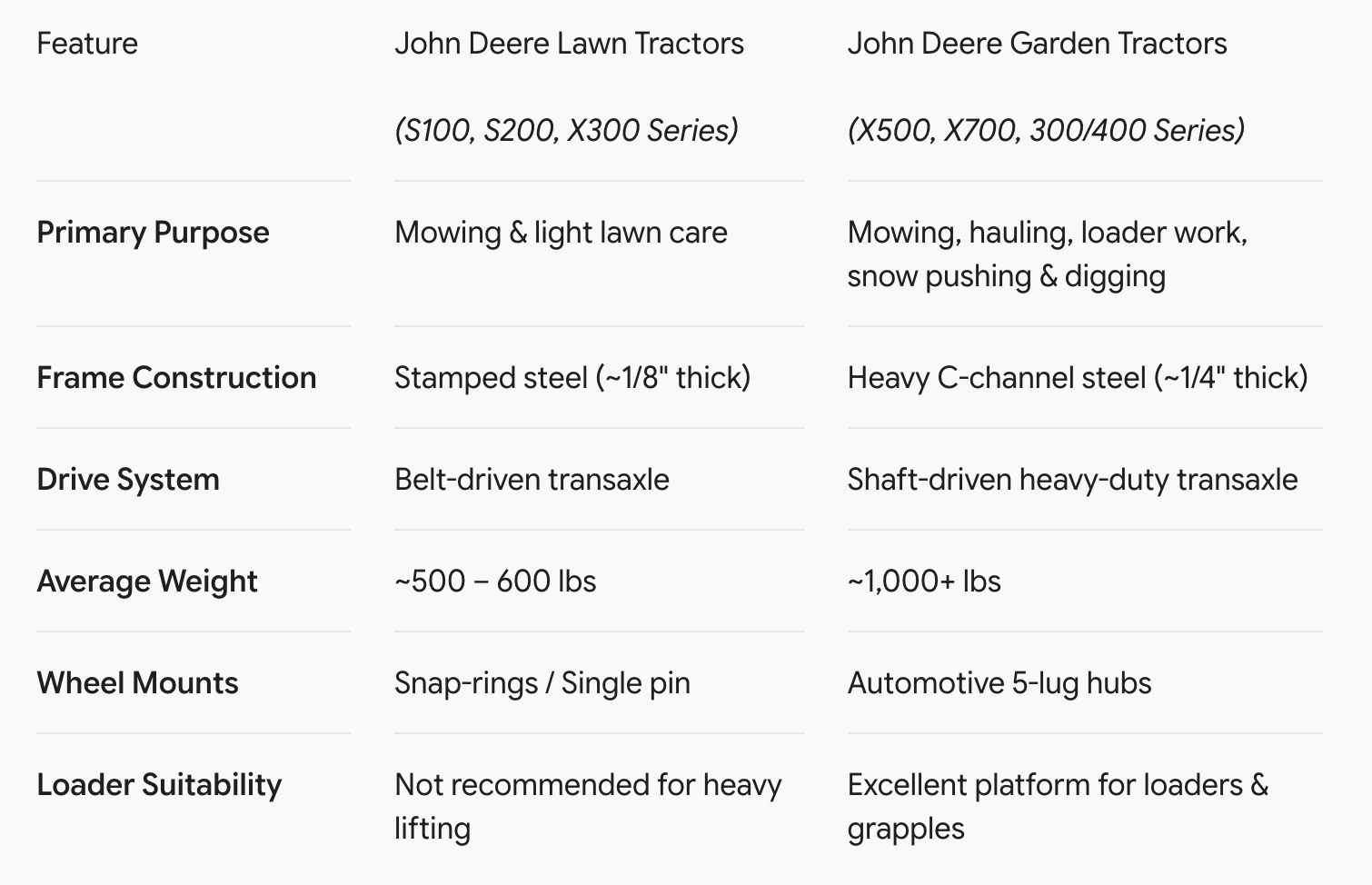
John Deere Lawn Tractors (e.g., S100, S200, X300 Series): Designed primarily for cutting grass and towing light lawn carts. They feature lighter-gauge stamped steel frames (around 1/8" thick) and lighter front axles optimized for maneuverability.
John Deere Garden Tractors (e.g., X500, X700 Series, and classic 300 series, 400/420/430, 425/445/455 models): Built as true mini-utility tractors. They utilize heavy-gauge, C-channel steel frames (around 1/4" thick and up to 9" deep) paired with heavy cast-iron front axles built to support heavy front-end and rear loads.
As highlighted by Florida Deere in his video above, a heavy-duty John Deere garden tractor (like a 455) weighs around 1,000+ lbs, compared to ~500–550 lbs for a John Deere X300 series lawn tractor. That extra weight provides essential ballast and stability when carrying heavy front-loader payloads.
2. Transmissions & Axles: Belts vs. Shafts
The transmission (transaxle) dictates how much pulling and lifting force your machine can handle:
Lawn Tractors: Typically equipped with entry-level belt-driven hydrostatic transaxles (like the Tuff Torq K46 or K58). These are great for smooth mowing, but heavy front-end lifting or pushing can strain the belt and transaxle over time.
Garden Tractors: Feature heavy-duty, shaft-driven transaxles (such as the Tuff Torq K90 series). Many models feature hydraulic power steering, hydraulic lift levers, and differential traction locks to handle massive torque without slipping.
3. Ground Engagement & Attachment Capability
John Deere Lawn Tractors: Perfect for mower decks, baggers, and light pull-behind dethatchers. They aren't engineered for heavy front-end loaders or ground engagement tools.
John Deere Garden Tractors: Purpose-built for ground engagement and heavy attachments. Their reinforced chassis and heavy axles make them the ultimate platform for front-end loaders, mechanical grapples, snow pushers, 3-point hitches, and tillers.
John Deere Model Cheat Sheet
The Bottom Line: Right Tool for the Right Job
If your main job is keeping two acres of lawn neat and trimmed, a John Deere lawn tractor is a fantastic machine.
However, if you're clearing brush, hauling firewood, moving gravel, or pushing winter snow, stepping up to a John Deere garden tractor gives you the beefy frame, shaft drive, and stability needed to turn your machine into an all-season workhorse.
At the end of the day, it’s all about protecting your back and getting the job done.